
Creating Compelling Visual Narratives: The Power of 3D Motion Design
In today's digital landscape, capturing and maintaining audience attention is more challenging than ever. Static images and traditional video content are no longer enough to stand out in a crowded marketplace. This is where 3D motion design comes in—not just as a technical skill, but as a powerful storytelling medium that can create deep emotional connections with audiences.

If you're building products that need both robustness and a strong narrative, you may also want to explore building resilient digital products and how AI in business is changing the way we design experiences end-to-end.
The Evolution of Visual Communication
Visual communication has evolved dramatically over the past decade. We've moved from static images to dynamic content, from 2D graphics to immersive 3D experiences. This evolution isn't just about technological advancement—it's about meeting changing audience expectations.
Modern audiences, particularly younger demographics, have developed sophisticated visual literacy. They can spot generic stock imagery from a mile away and have come to expect high production values across all touchpoints. More importantly, they crave authentic, emotionally resonant content that tells a story.
Why 3D Motion Design Matters
3D motion design offers unique advantages in visual storytelling:
Dimensional Thinking
Unlike 2D design, which operates on a flat plane, 3D design allows us to think and create in three dimensions. This opens up new possibilities for:
- Depth and Perspective: Creating visual hierarchies and drawing attention to key elements
- Realistic Lighting: Using light and shadow to create mood and atmosphere
- Dynamic Camera Movements: Guiding the viewer's eye through complex narratives
- Physics Simulation: Creating realistic motion that feels natural and engaging
Emotional Resonance
3D motion design can create emotional impact in ways that 2D design cannot:
- Tactile Quality: 3D objects feel more real and tangible, creating stronger emotional connections
- Cinematic Language: We can use film techniques like depth of field, camera movement, and lighting to create mood
- Metaphorical Expression: Abstract concepts can be visualized in concrete, relatable ways
- Temporal Storytelling: Motion allows us to show processes, transformations, and journeys over time
Our Approach to Visual Storytelling
At ZPro, we approach 3D motion design as a storytelling discipline, not just a technical one. Here's our framework:
1. Narrative First
Before we open any 3D software, we start with the story:
- What is the core message? What do we want the audience to feel, think, or do?
- Who is the audience? What visual language will resonate with them?
- What is the emotional arc? How do we want the audience to feel throughout the experience?
- What are the key moments? What are the most important beats in the narrative?
2. Conceptual Development
Once we understand the narrative, we develop the visual concept:
- Style Exploration: What visual style best supports the story? Realistic? Stylized? Abstract?
- Color Psychology: How can we use color to enhance the emotional impact?
- Motion Language: What kind of movement feels right for this story? Smooth and flowing? Sharp and energetic?
- Symbolic Elements: What visual metaphors can we use to communicate complex ideas?
3. Technical Execution
With the concept established, we move to technical execution:
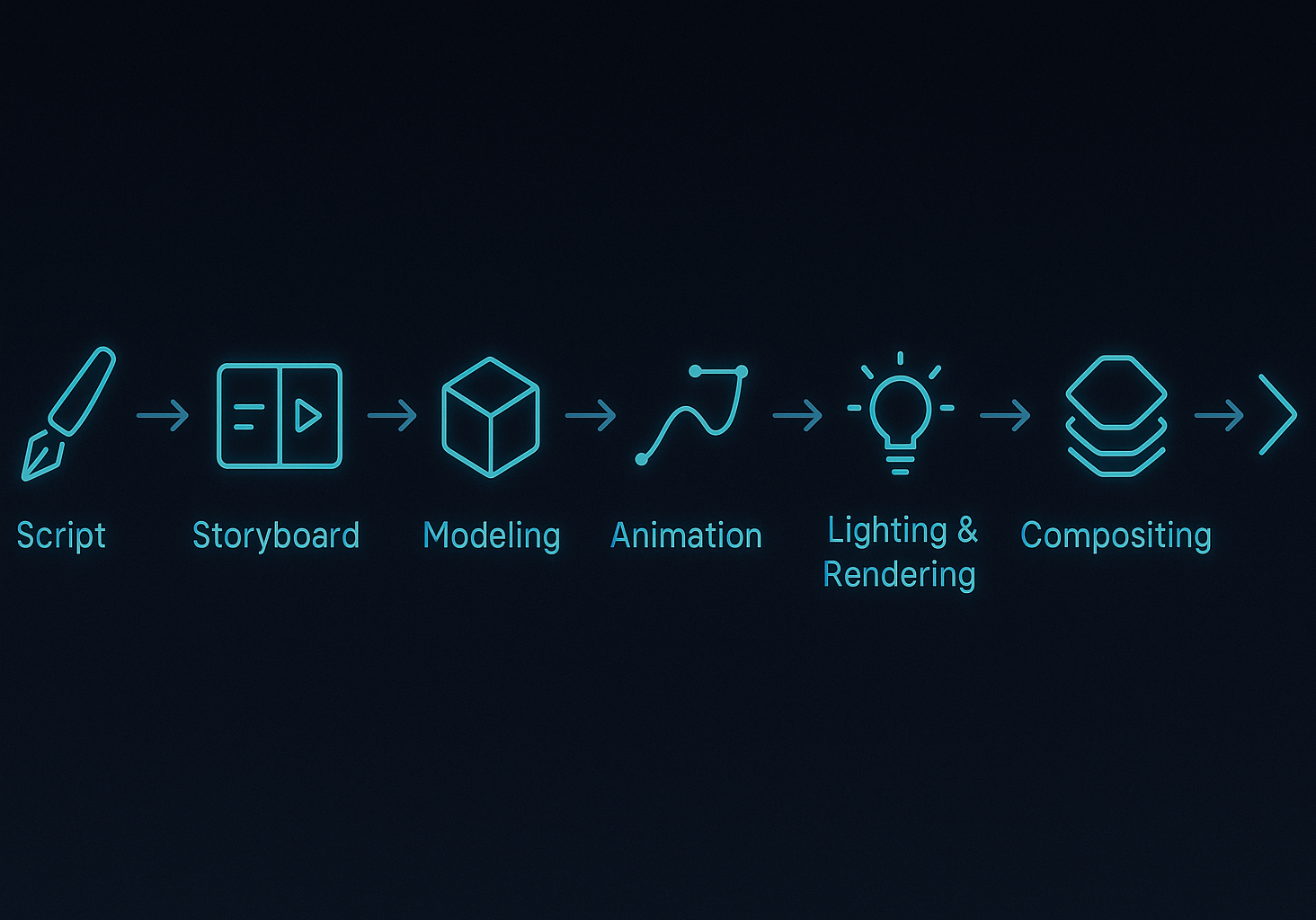
- 3D Modeling: Creating the digital assets needed for the story
- Animation: Bringing the models to life with purposeful movement
- Lighting Design: Using light to create mood, depth, and focus
- Rendering: Producing the final imagery with attention to detail and quality
- Compositing: Combining elements and adding final polish
Case Study: Product Visualization Project
Let me share a recent project that illustrates these principles:
Challenge: A B2B software company needed to explain their complex data integration platform to non-technical decision makers.
Approach: Instead of creating a traditional explainer video, we developed a 3D motion piece that used visual metaphors to make abstract concepts concrete:
- Data as Water: Flowing, connecting, and transforming through the system
- Integration as Architecture: Building blocks coming together to form structures
- Security as Force Fields: Protective barriers that adapt and respond to threats
Result: The video achieved 3x higher engagement than their previous content and helped close several major deals. The visual metaphors made complex technical concepts accessible to business stakeholders.

Technical Considerations
Creating compelling 3D motion design requires both artistic vision and technical expertise:
Software and Tools
Our toolkit includes:
- Cinema 4D: Our primary 3D software for modeling, animation, and rendering
- After Effects: For compositing, motion graphics, and final polish
- Octane Render: For photorealistic rendering with realistic lighting
- Houdini: For complex simulations and procedural effects
- Adobe Creative Suite: For supporting 2D elements and post-production
Optimization for Different Platforms
Different platforms have different requirements:
- Web: Optimized file sizes, responsive design considerations
- Social Media: Platform-specific aspect ratios and duration limits
- Presentations: High resolution for projection, file size considerations
- Broadcast: Technical specifications for television and streaming
Trends and Future Directions
The field of 3D motion design is constantly evolving. Some trends we're watching:
Real-Time Rendering
Game engines like Unreal Engine are becoming viable for motion design work, allowing for real-time feedback and iteration.
AI-Assisted Creation
AI tools are beginning to assist with tasks like modeling, texturing, and even animation, freeing up artists to focus on creative direction. Paired with an AI second brain, this can dramatically speed up ideation and iteration.
Immersive Experiences
AR and VR are creating new opportunities for 3D motion design in immersive environments.
Interactive Narratives
Combining 3D motion design with interactive elements to create engaging, user-driven experiences.
Best Practices for Organizations
If you're considering 3D motion design for your organization, here are some best practices:
Start with Strategy
Don't use 3D motion design just because it looks cool. Make sure it serves your strategic objectives and resonates with your audience.
Invest in Quality
Poor 3D work can look amateurish and damage your brand. Invest in quality execution or work with experienced professionals.
Think Long-Term
Develop a library of 3D assets that can be reused and repurposed across different campaigns and platforms.
Measure Impact
Track the performance of your 3D motion content to understand what resonates with your audience and drives results.
Conclusion
3D motion design is more than just a technical skill—it's a powerful medium for visual storytelling that can create deep emotional connections with audiences. When done right, it can transform how organizations communicate, differentiate their brand, and engage with customers.
As we move into an increasingly visual and immersive digital future, the ability to create compelling 3D motion content will become a key competitive advantage. Organizations that invest in this capability today will be well-positioned to capture attention and drive engagement in tomorrow's marketplace.
The key is to approach 3D motion design not as a technical exercise, but as a storytelling discipline that combines artistic vision, strategic thinking, and technical expertise to create experiences that resonate with audiences and drive business results.